We began our trip to the Arctic Circle with a little aprehension. We were aware of the horror stories of some fellow travelers and the conflicting stories of others that had no problems at all. It didn’t help that a mile or two onto the Dalton Highway there was a car with its window completely shattered and caved in. We swallowed hard, and powered on.
Not too far past the damaged car we saw a momma moose and her young calf on the road. On seeing and more likely hearing us (our little diesel is louder than most vehicles and does sound a bit like a low growl) they quickly scampered into the woods. DR was only able to get a butt shot as they disappeared.
Now, mind you, we are no strangers to dirt roads, having driven the “Top of the World Highway” that included over 100 miles of dirt roads.
We noticed quite a bit of smoke in the air on the Elliott Highway. Laura checked and was relieved that the fire near the Elliot Highway was no threat. A short time later we drove by the back fire she had read about.
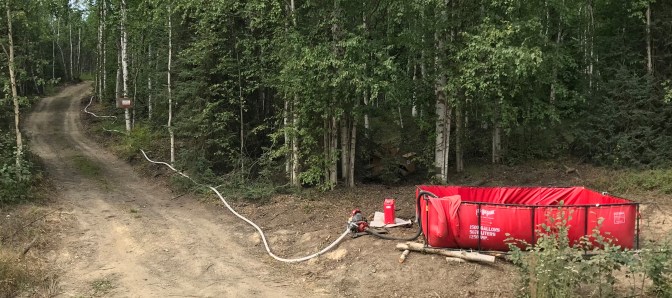
DR, as part of his involvement in our mobile home park’s emergency response team, had studied fire fighting as fire is probably the biggest threat to mobile home parks in major disasters. He snapped a picture of a hot shot crew’s setup that he would like to replicate in our park that could use water from the lake and swimming pool to stop the spread of fire between our mobile homes. The current plan is to let them burn and maybe stop the fire from crossing streets.
The Dalton Highway was originally called the “haul road” because it was built to haul the equipment and materials needed to build the Trans-Alaska Pipeline, which was our constant companion on our trek North.
A culvert is a large usually corrugated pipe laid under a roadway to allow existing waterways to flow under rather than destructively over a roadway. DR noticed that every culvert had a small 1/2 to 3/4 inch pipe pulled through the culverts with both ends of the pipe bent up and secured close to the edge of the roadway. DR became obsessed with finding the purpose and story behind these small pipes.
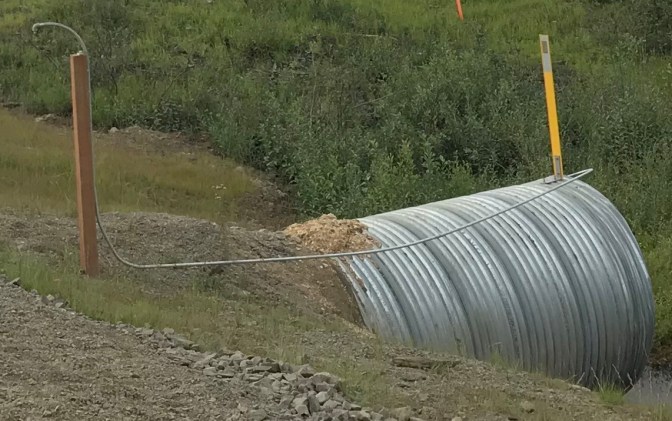
The ladies at the information shack were no help in figuring out what purpose the small pipes served. So when we were back on the Internet, DR sought help by putting a question on Quora, a site specifically frequented by brainiacs just for asking geeky questions. Sure enough, in just a matter of minutes, DR got several proper and thorough answers to his question. For the geeks reading this, here is a link to DR’s Quora question. The short answer is that they are “thaw pipes” and during the spring breakup, when water starts to flow again, the water in the culverts is frozen solid, and the roadway forms a dam that threatens to overflow and damage the roadway. While this is happening road maintenance crews drive up and down the road in “steam trucks”. They hook up to the small pipes and heat the pipe with steam until there is enough of the above freezing runoff water passing through the culvert to completely thaw out the culvert.
We thought we would not see tundra as we were not going to cross the Brooks Range onto the North slope, but as it turned out there was a stretch of tundra just before our destination, the Arctic Circle Sign.
At the Arctic Circle Sign, Laura took pictures for fellow tourists that were there and we took our trophy photo on a tripod.
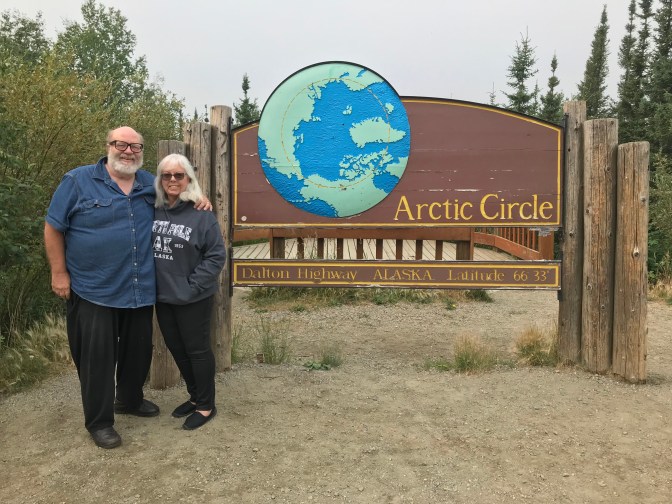
DR being DR had researched that the sign was no longer at the real Arctic Circle and due to precession of the earth had moved North to 66° 33′ 47.7”.
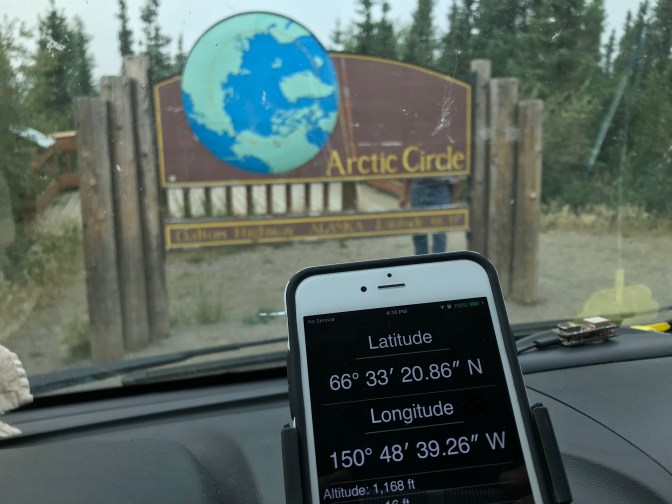
So we drove past the sign just to make sure we crossed the current Arctic Circle because there are some people that would challenge DR on such trivial things. Here is our actual turn around point.
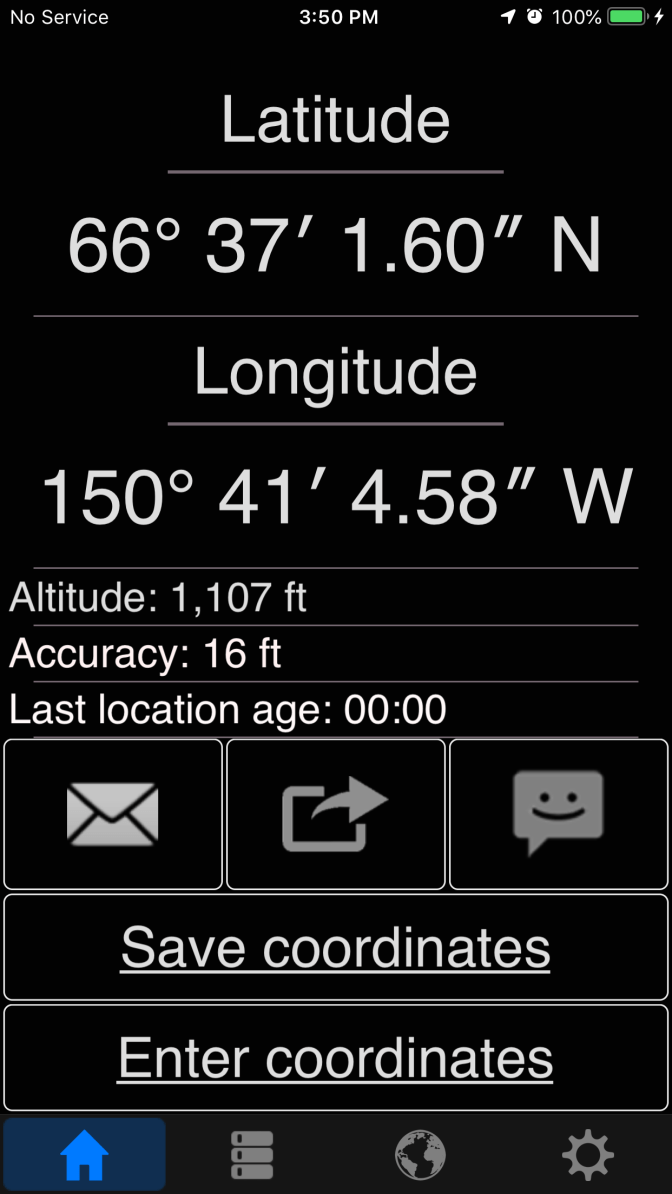
There is a small free campground about a half mile from the Arctic Circle Sign. So we took advantage of it. When we awoke in the morning and were ready to depart our battery was dead. Evidently, sometime during the evening DR read that you are supposed to keep your lights on at all times on the Dalton Highway so he switched on our headlights assuming that because the ignition was off that the headlights would not come on until we started the engine in the morning. Ooops. The advantage of having both a starter chasis battery and a separate house battery bank for our domestic needs is that you can jump the starter battery from the house battery bank. However, our jumper cables where not long enough. Because the two battery banks share a common negative DR split the jumper pair and connected them end-to-end and Laura sighed a huge sigh of relief when the engine started, as we were very much alone and a long ways from help.
A minute later as we turned onto the exit for the campground we saw a grizzly bear just as he saw us and he took off into the brush.
On the way back down to Fairbanks we stopped to take a better picture of a “thaw pipe” and noticed a wrecked motorcycle in the mud next to the culvert. We hollered and scanned the vicinity for signs of life. A passing Southbound truck stopped as well and proceeded when we finally continued, assuming the scene was old.
At the Yukon River crossing there is a visitors center in a small log cabin. It was very cozy with a wood stove and chairs and a lovely lady named Sheila who was eager and knowledgable in answering our questions. This is where we got our certificates for crossing the Arctic Circle. She made a call on our behalf to find out what the thaw pipes were and got some bogus answer which she gladly shared. A gal named Chris was also in the cabin and was a supply person waiting for a delivery of fire fighting equipment for the fire fighters battling the “Grouse Creek Fire”. Sheila told the story behind the crashed motorcycle at milepost 89. She knew that it had happened a couple of weeks prior and the local authorities had determined that it was apparently an abandoned stolen motorcyle. Sheila had a map with all the United States and pins in all the ones from which she had had visitors. Hawaii and West Virginia were the only holdouts. While we were there a couple came in and he was from Hawaii. Sheila was very excited to add the second to the last pin to her map.
As far as our fear of the roads go, we know now that we would rather drive on a well maintained dirt road as opposed to a pot-hole riddled asphalt road. On the asphalt you are constantly trying to dodge pot-holes, and if you don’t succeed in dodging them they can be quite brutal. DR’s dad, Lowell, has always said, and we repeat it often, if you are uncomfortable driving then “SLOW DOWN”. We probably averaged 40 mph going up and 30 mph coming down.
As for our windshield fears, our windshield is no worse than it was going in. It was heartening to see that on the Dalton Highway, at least, opposing traffic, even big rigs, slow down and get as far over as possible when approaching oncoming vehicles. We had one windshield hit, but no further damage, from one of the few big rigs that didn’t follow this courtesy.


 VanGo.blog
You made it! Huzzah!
LikeLiked by 1 person
Hooray! Now all you have to do is drive across the Antarctic Circle, & you will have done everything! Congrats!!!
LikeLiked by 1 person